

Living with a chronic lung condition can make everyday tasks feel like mini marathons. Simple activities like getting dressed, cooking a meal or climbing a few steps can leave patients feeling breathless, exhausted and frustrated. Over time, this can lead to avoiding activities altogether, affecting confidence, independence and quality of life.
This is where Energy Conservation Techniques play a powerful role in pulmonary rehabilitation. They help patients use their energy more efficiently, allowing them to do more with less breathlessness and with greater independence.
What are energy conservation techniques?
Energy conservation techniques are simple, practical strategies that reduce the physical and respiratory effort required to perform daily activities. Instead of pushing through breathlessness, patients learn how to move, when to rest, and where to simplify tasks so their lungs and muscles are not overworked. Energy conservation involves changing an activity or the environment to decrease the level of energy required to complete a task.1
Core principles of energy conservation
Living with a chronic lung condition often means rethinking how daily activities are done. While activities may not be performed in the same way as before, small adjustments can help patients save energy, manage breathlessness and continue doing what matters most to them.
‘Helping patients do more with less breathlessness’
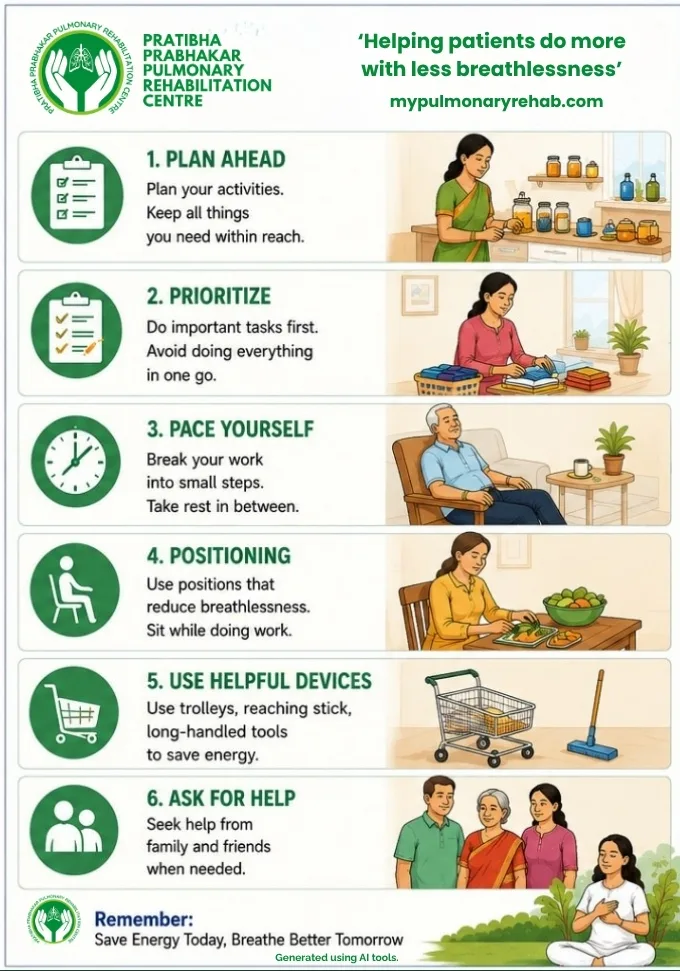
Practising the 5 P’s of energy conservation can help patients manage fatigue more effectively and stay in control of their daily routine.2
1. Pace
Activities should be performed at a slow and steady pace, avoiding unnecessary rushing. Regular rest breaks should be incorporated between tasks, and rest is recommended before exhaustion develops. Excessive fatigue may prolong recovery time and worsen breathlessness.
2. Plan ahead
Too many physically demanding activities should not be scheduled on the same day. For example, avoid heavy household chores, grocery shopping and attending appointments all in one day. Spreading activities across the week helps prevent fatigue from building up.
3. Position yourself well
An upright posture should be maintained while sitting and standing. Whenever possible, tasks should be completed in a seated position rather than standing. Excessive bending, reaching, or remaining in one position for prolonged periods should be avoided, as these may increase breathlessness and fatigue.
4. Prioritise your activities
Activities should be prioritised according to importance and urgency. More demanding tasks are best completed when energy levels are highest, while less demanding activities can be reserved for later.
5. Pursed-lip breathing
Pursed-lip breathing is used to improve breathing efficiency and help keep the airways open for longer during exhalation. Regular practice of this technique may help improve the control of breathlessness during activities. With continued practice, it can become a natural response during episodes of shortness of breath.
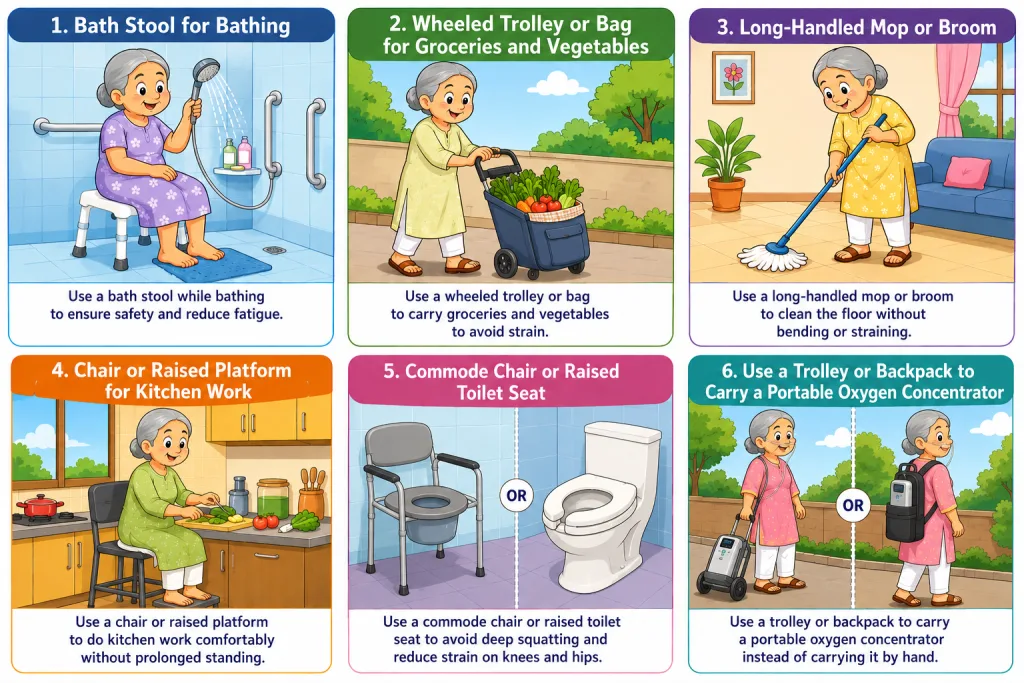
Along with practising the 5 P’s, simple and easily available tools can further reduce effort and breathlessness during daily activities. Assistive devices help maintain good posture, minimise bending and lifting, and make pacing tasks easier.
Common examples include:
- Bath stool bathing
- Wheeled trolley or bag for groceries and vegetables
- Long-handled mop or broom
- Chair or raised platform for kitchen work
- A commode chair or raised toilet seat can prevent deep squatting
- Use a trolley or backpack to carry a portable oxygen concentrator instead of carrying it by hand.
Simplifying the home environment
Once suitable assistive devices are in place, small changes to the home setup can further conserve energy during daily activities. Organising the environment to reduce unnecessary movement, bending and prolonged standing helps limit fatigue and breathlessness.
Simple changes include:
- Storing frequently used items at waist height
- Using slip-on footwear
- Choosing lightweight cookware and utensils
- Sitting while chopping vegetables or ironing
Even minor environmental modifications can make everyday tasks easier and less tiring.
At the end of each day, patients should reflect on which activities felt tiring and which strategies worked well. Small adjustments can then be made to make the following day easier and more manageable.
Key take-home message for patients
Energy conservation techniques can help patients manage breathlessness and fatigue more effectively, enabling them to stay active, perform daily activities with greater ease, and maintain independence. By working smarter rather than harder, patients can conserve energy for the activities that matter most to them.
Energy conservation is not about doing less, it is about doing things differently.
References
- Energy Conservation Techniques to Decrease Fatigue
Vatwani, Archana et al.Archives of Physical Medicine and Rehabilitation, Volume 100, Issue 6, 1193 – 1196
Vatwani A, Margonis R. Energy Conservation Techniques to Decrease Fatigue. Arch Phys Med Rehabil. 2019 Jun;100(6):1193-1196. doi: 10.1016/j.apmr.2019.01.005. Epub 2019 Apr 5. PMID: 30955793.